
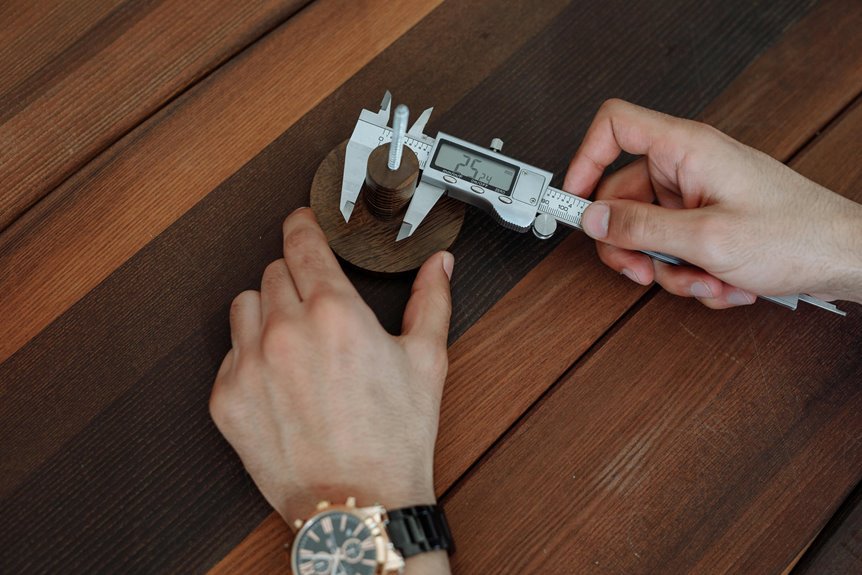
Wood moisture meters aren’t perfectly accurate—they’re precise, meaning consistent, but that’s different. Quality meters get within 0.1% of true moisture content; budget models drift 5–20% depending on wood species, density, and calibration. Pin-type meters penetrate deeper for reliable depth readings, while pinless scans surface areas faster. Temperature, humidity, and where you measure matter enormously. Take three readings across different spots, compare against oven-dry standards, and recalibrate yearly. Your meter’s trustworthiness depends on how you use it—there’s much more to reliable measurement than the number on the display.
What “Accuracy” Actually Means (Precision Isn’t the Same Thing)
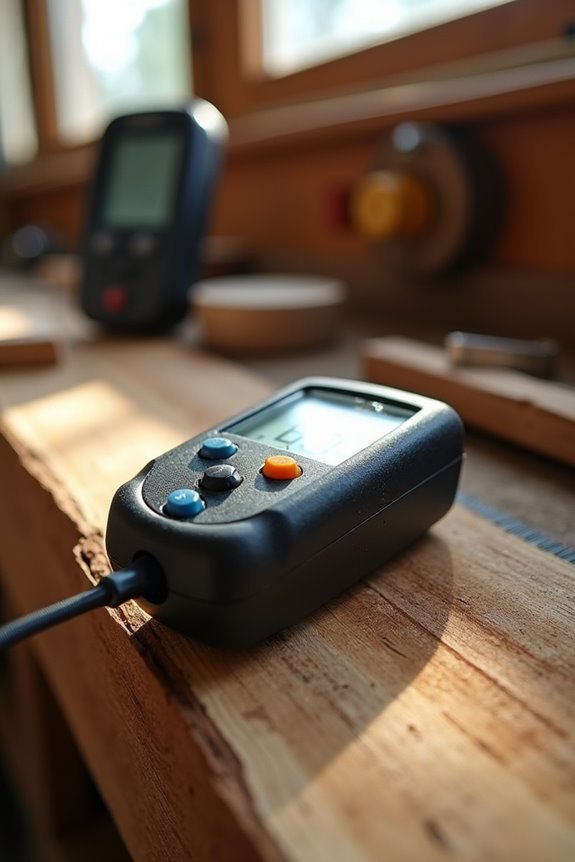
Why do two moisture meters sometimes give you completely different readings when you’re testing the same piece of wood? The answer lies in understanding accuracy versus precision—a distinction that matters more than you’d think.
I’ve learned that precision means your meter gives consistent results repeatedly. Accuracy, however, means those results match the true moisture content. A meter can be precise yet wildly inaccurate if its readings deviate from oven-dry reference standards.
Professional meters target accuracy within a few percentage points, while budget models can swing 5–20% off. This happens because accuracy depends on calibration, material density, temperature, and correct species selection. Think of it like aiming at a target: precision is hitting the same spot repeatedly, but accuracy means hitting the bullseye. Both matter when you’re serious about your wood.

Instant & Accurate Readings – Measures up to 12mm deep for precise wood moisture results. Save readings with the convenient Hold function

✅【Accurate & Trusted Measures, Identify Moisture Level】With accurate & trusted performance, Mecurate moisture meter can detect moisture content from wood to building material. A reliable must-have tool for home owners, woodworkers, painters & architects to detect moisture level and spot hidden damage, which would save potential expensive repairs.

HUMIDITY SENSOR: Our handy meter tool can quickly determine what level of remediation is needed to keep your family safe from black mold. High levels of dampness that go untreated are the leading cause of harmful fungus growth in the home.
Pin or Pinless: Which Reads More Accurately?
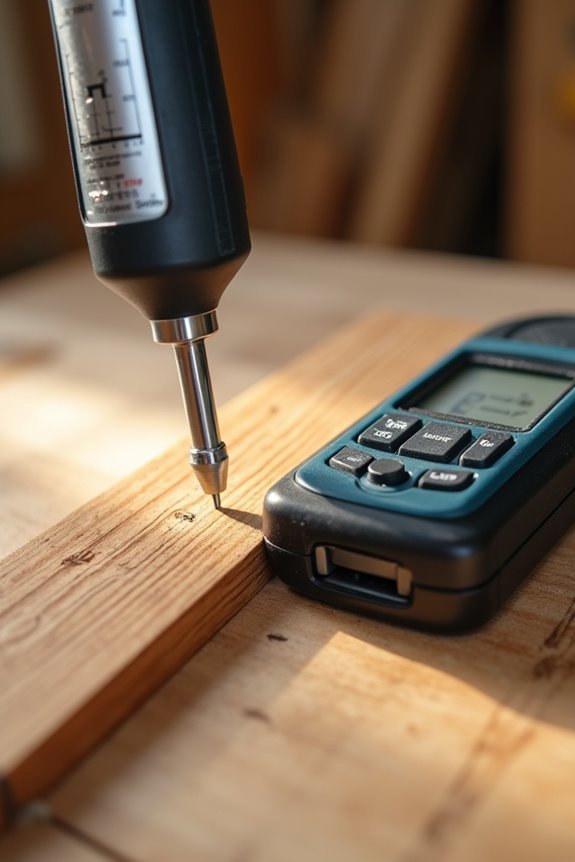
When you’re standing in a woodworking shop comparing two meters—one with pins and one without—you’re really asking which technology gets you closer to the truth.
Pin-type meters penetrate deeper into wood layers, delivering spot-specific readings perfect for detecting moisture trapped inside beams or subfloors. They’re your precision tool.
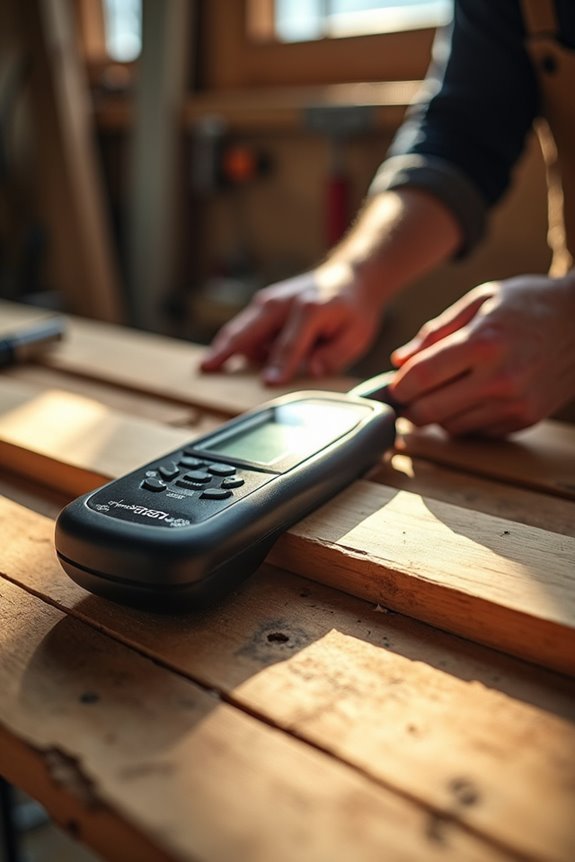
Pinless meters scan broad surface areas using electromagnetic signals without invasion. They’re fast, but density variations can throw them off.
Here’s what I’ve learned: neither wins universally. Pin-type offers more reliable depth-specific data through calibration and proper species settings. Pinless works well for quick surveys when surfaces are even. Combining both methods yields the best accuracy. High-quality meters hit within 0.1% moisture content—cheap ones? They’ll drift 5–20%, leaving you guessing.

WATER LEAK DETECTOR detects relative moisture content from leaks and flooding

Dual Measurement Modes: Pin and Pinless measurement options for versatile moisture detection on various materials.

Moisture Meter: This pinless moisture meter lets you measure moisture in wood, drywall, and concrete without damaging surfaces—ideal for checking and inspecting flooring and walls.
Why Expensive Meters Beat Budget Models
The choice between pin and pinless methods matters, but there’s another layer to accuracy that separates the woodworkers who trust their readings from those who second-guess them: your meter’s price tag.
Premium meters achieve what budget models can’t: consistency. You’re looking at 0.1% accuracy versus readings that drift 5–20%, which means your expensive meter won’t lie to you next Tuesday. Here’s what you’re actually paying for:
Built-in advantages: Premium meters offer calibration options, species settings, and temperature compensation—features that automatically adjust for different woods and conditions. Budget models? They guess.
Real reliability: Better build quality means your meter stays stable for years, while cheaper versions drift and need constant recalibration. You’re investing in dependable trend tracking across your projects.
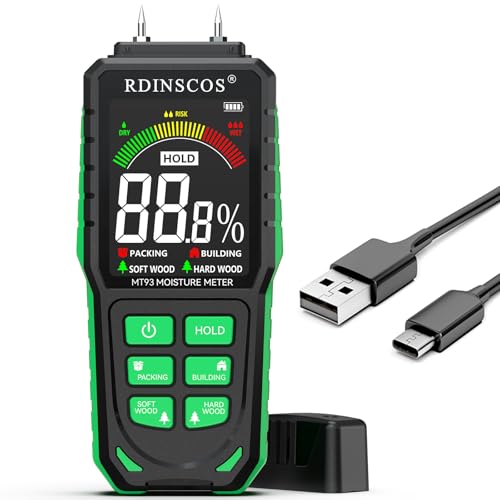
Efficient & Accurate Moisture Detection for Multiple Surfaces This rechargeable moisture meter uses sharp, durable pins to penetrate deep into wood, drywall, and hardwood, ensuring precise detection of hidden moisture issues. Perfect for home improvement, construction, and DIY projects where accurate moisture readings are essential

Accurate Pin-Type Measurement: Designed with 2 high precision pins. For an accurate test read, stick the stainless steel pins into the surface of what you're measuring. penetrate into the test surface and quickly know the moisture level in your walls, Remove all of the guesswork with this moisture detector

🌲【Accurate and fast measurements reveal hidden water leaks】: It has 2 high-precision pins that can penetrate the surface to be tested and quickly measure moisture content to estimate potential moisture increase throughout the home. COCZOW moisture meter is the ideal tool for measuring moisture.
Why Your Readings Drift: User Error, Calibration, and Material Factors
You’ve bought a quality meter, calibrated it carefully, and yet your readings still jump around—that’s not necessarily the meter’s fault.
Your user technique matters enormously. Improper insertion depth, inconsistent pin contact, or testing at the wood’s edge instead of its core creates variations up to several percentage points. Calibration drift happens too; meters drift between factory and field readings, so verify yours every 1–2 years.
| Factor | Impact | Solution |
|---|---|---|
| Wood species | Density varies significantly | Use species-corrected settings |
| Surface conditions | Paint/sealant alters readings | Prepare surfaces properly |
| Moisture distribution | Core differs from edge | Test the wood’s center |
| Temperature changes | Affects conductivity | Acclimate before testing |
| Technique consistency | Insertion depth matters | Develop repeatable method |
Material factors—species, density, temperature—significantly affect results. Surface conditions like fresh paint or dampness produce unreliable values without proper preparation. You’re not imagining those drift patterns; you’re simply discovering why consistency beats perfection.

High-precision measurement: The paper moisture meter has a high accuracy of ±0.5% and a measurement range from 0% to 95%. It is commonly used in Paper manufacturing, packaging, waste paper recycling, furniture manufacturing, particleboard and wood-based panels, printing and publishing, charcoal manufacturing industry.

Pin Type Moisture Meter – Two pins penetrate up to 12mm into wood for accurate moisture readings. The handy Hold function freezes the display, so you can record the measurement with ease

High Accurate Measurement: The wood moisture meter could help you to measure wood by sensitive pins at the range of 0-99.9% and the accuracy is less than ±0.5%.
Why Wood Species and Density Throw Off Meter Accuracy
If you’ve noticed that your moisture meter reads 12% in oak but 15% in pine—even though both pieces came from the same storage room—you’ve encountered one of moisture metering’s most persistent problems: wood species and density affect electrical resistance readings significantly. Different woods have different cell structures and electrical properties, so the same actual moisture content produces different sensor outputs depending on what species you’re testing. Without adjusting your meter’s calibration settings to match the specific wood you’re working with, you’ll end up with systematic errors that can shift your readings by several percentage points in either direction.

Wide measuring range:0~99.9%;Accuracy:± 0.5%,resolution:0.1% Large screen digital display, easy to read,Probe protection cover design, cover when not in use to avoid injury...
Electrical Resistance Variation
Why does a moisture meter give wildly different readings when you test oak versus pine, even when both pieces feel equally damp? The answer lies in electrical resistance—a hidden property that changes dramatically between wood types.
Denser woods like oak have higher resistance, meaning electricity moves through them slowly. Your meter interprets this sluggish flow as lower moisture, even when moisture content is identical to lighter pine. Without proper species calibration, you’re reading the wood’s density rather than its actual dampness.
This density effect compounds with anisotropy—wood’s directional inconsistency. Grain orientation and internal structure scatter readings further. The solution? Use your meter’s species settings or reference calibration data matching your specific wood. That alignment improves accuracy by accounting for the wood’s physical properties.
Calibration Specificity Matters
that shiny new meter you bought comes preset for “generic softwood,” and you assume it’ll work fine on your oak dresser or pine flooring.
I learned this the hard way. Species-specific calibration matters because different woods have distinct carbon content and lignin composition—their dielectric properties differ. Dense hardwoods like oak yield higher resistance readings than softwoods at identical moisture levels. If you don’t adjust your meter’s density settings, you’ll systematically underestimate moisture content by several percentage points.
Manufacturers provide calibration blocks matched to specific wood types for good reason. Using the wrong species setting introduces errors beyond acceptable margins. Your meter’s accuracy depends on matching both wood type and measured density to what the meter expects.
Temperature, Calibration, and Environmental Factors
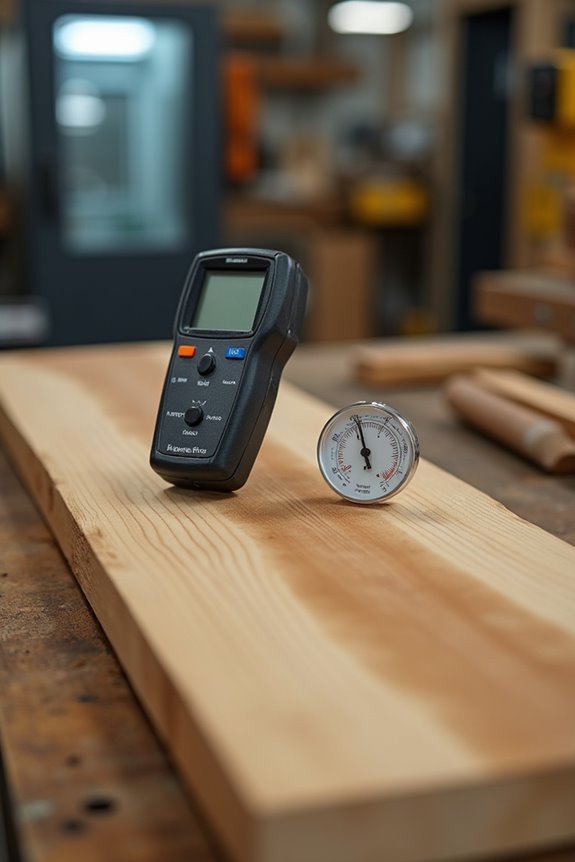
Because moisture meters rely on measuring how electricity moves through wood, the conditions surrounding that wood matter more than you’d think.
Moisture meters measure electrical conductivity through wood—environmental conditions matter far more than most realize.
I’ve found that temperature swings throw off readings significantly. Testing at room temperature—around 70°F—gives you the most reliable accuracy. When conditions shift, your meter drifts too.
Calibration isn’t a one-time thing. I recalibrate mine regularly because field-use gradually pushes readings off track. High-quality meters maintain accuracy within 0.1% MC under proper conditions; cheaper ones show greater variability.
Environmental factors deserve attention. Surface moisture, condensation, and humidity bias results if overlooked. Wood density and species also interact with temperature, complicating readings.
These three elements—temperature stability, consistent calibration, and controlled environmental factors—work together. Ignore them, and accuracy suffers. Master them, and your measurements become genuinely trustworthy.

COMPACT, PIN STYLE DESIGN: Reliably measure moisture content in wood, drywall, and other building materials with the precision of most standard-size meters - all in a lightweight, portable design

INSTANT & ACCURATE READINGS – Quickly measures moisture content to a depth of approximately 12 mm in wood, drywall, concrete, and building materials. Easily capture precise readings using the convenient hold function, ideal for woodworking, home inspections, and detecting water damage

PIN & PINLESS DETECTION IN ONE TOOL: Quickly scan for moisture with the pinless sensor, then flip open the cap to use pin mode for precise readings; ideal for drywall, subfloors, studs, and more
Reading the Numbers: What 12% vs. 35% Actually Tells You
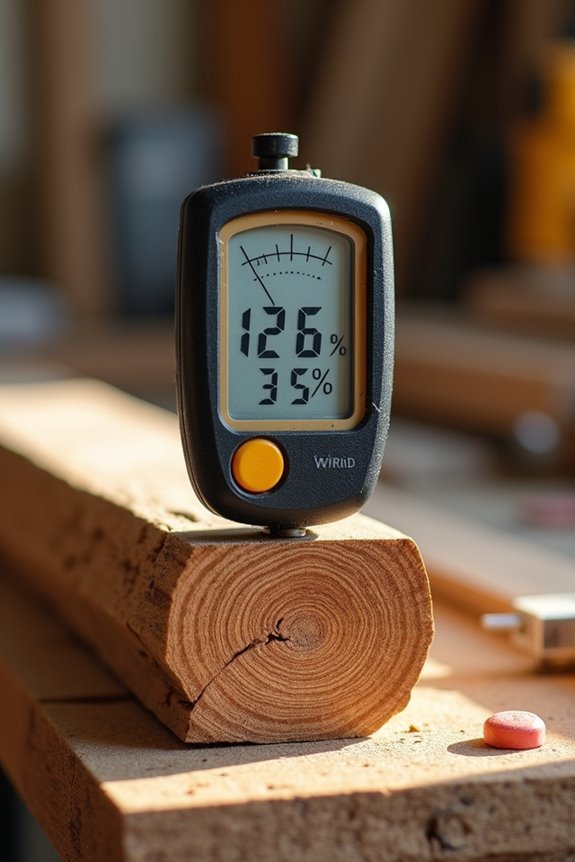
When you’re staring at your moisture meter and it displays 12% instead of 35%, you’re looking at two completely different situations—and the difference between these readings matters significantly for your project.
A 12% reading signals wood that’s dry and ready to work with, whereas 35% indicates trouble: mold risk, decay potential, and serious drying ahead. Here’s what I’ve learned: accuracy variation depends heavily on sampling location. I’ve taken moisture meter readings from a board’s edge and found 12%, then checked the core and hit 35%. That’s not a meter failing you—that’s moisture hiding inside where you can’t see it.
Species corrections matter too. Without them, your percent moisture content reading might reflect the wood’s electrical properties rather than true dryness. Always verify multiple spots.
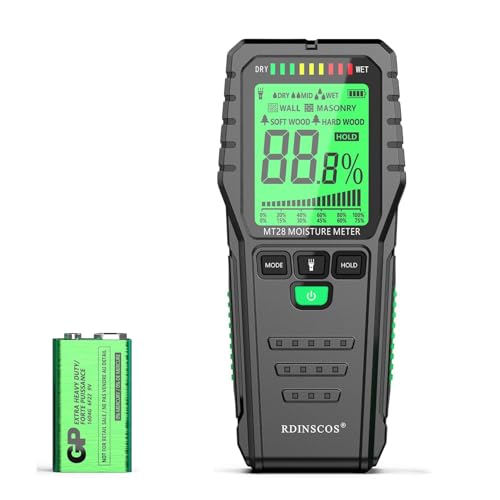
Moisture Meter for Home Inspection:Quickly identifies moisture from leaks, flooding, or humidity in basements, bathrooms, kitchens, and drywall—perfect for home inspectors and DIY repairs
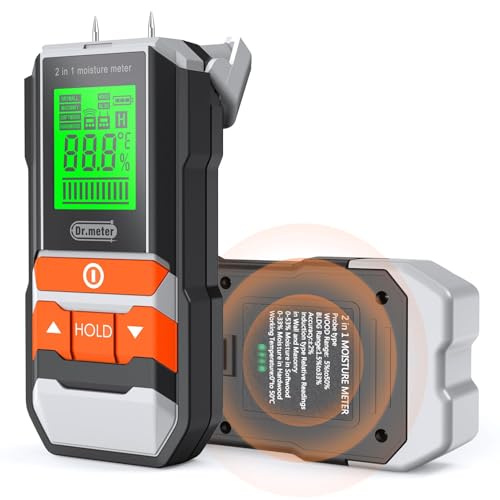
2-in-1 Moisture Meter: The 2-in-1 Dr.meter moisture meter offers ideal dual functions of pin-type and pinless scanning in one. The pinless scanning mode with non-invasive measurement is ideal for high-end wood and building materials. The pin-type mode with faster response and higher accuracy is great for all kinds of wood and building materials.

𝐀𝐜𝐜𝐮𝐫𝐚𝐭𝐞 & 𝐅𝐚𝐬𝐭: Povlen moisture meter uses advanced sensor technology and a smart chip for accurate moisture detection. It quickly measures moisture content with high-frequency waves and features a HOLD function for one-button recording
How to Test Your Meter Against Real Standards
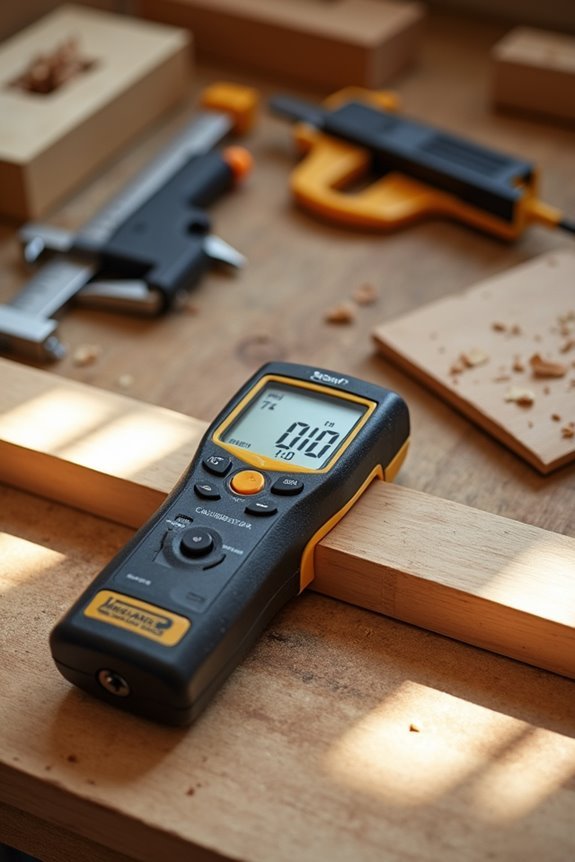
If you’ve ever wondered whether your meter’s readings actually match reality, testing it against real standards is the best way to find out. You can compare your meter’s results directly to oven-dry test results—the gold standard—or verify it using calibration blocks, which let you check whether your device is drifting from its original accuracy. These simple checks take just a few minutes and can save you from making costly decisions based on unreliable numbers.
Oven-Dry Test Comparison
How Do You Know If Your Moisture Meter Is Accurate?
I didn’t know until I learned about oven-dry testing. This method becomes your accuracy benchmark, revealing whether your meter’s reliable or just guessing.
The Process
You’ll weigh a wood sample, dry it completely in an oven, then weigh it again. That calculation shows your wood’s true moisture content. Your meter’s reading gets compared against this result—the closer it matches, the better your calibration and technique are working.
What You’ll Discover
Quality meters approach oven-dry results within 0.1% MC, while cheaper ones might miss by 5–20%. Testing different wood species reveals variability between meters. This comparison shows whether your equipment deserves trust or needs upgrading, exposing real performance across varying densities and moisture ranges.
Calibration Verification Methods
- Use certified calibration blocks or oven-dry reference samples with known moisture content values
- Record readings from multiple wood species and densities to assess accuracy across different materials
- Document environmental conditions like temperature and humidity, since these factors affect your readings
Compare your meter’s readings against these known standards. If discrepancies exceed your meter’s stated accuracy, recalibrate following the manufacturer’s instructions. This ongoing verification keeps your moisture content measurements reliable and trustworthy.
Get Reliable Readings: Probe Care, Calibration, and Testing Protocol
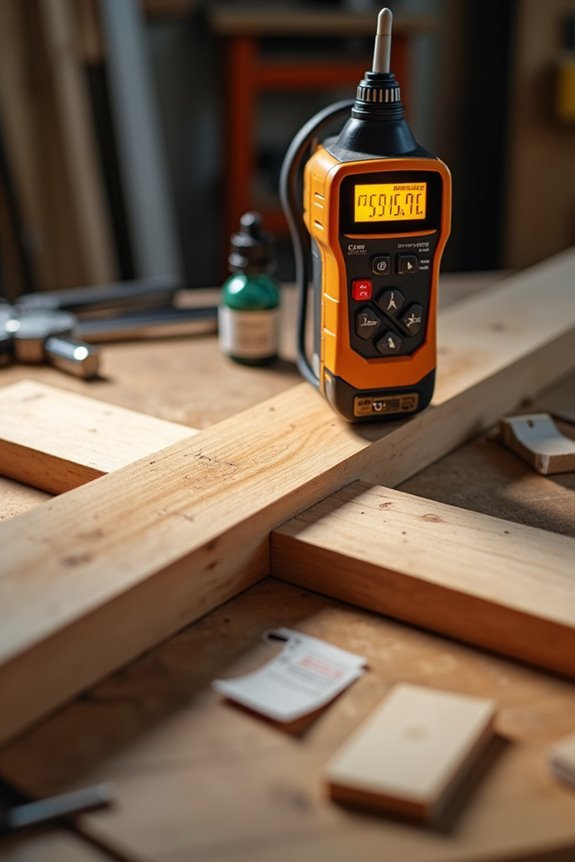
Want your moisture meter to actually tell you what’s happening inside your wood?
I’ve learned that reliable readings demand a straightforward testing protocol. First, take at least three readings across different spots—more for larger surfaces—because one measurement won’t cut it. I compare my results against oven-dry reference values for the specific wood species I’m working with; this cross-check reveals whether my meter’s telling the truth.
Calibration matters greatly. I verify my meter every 1–2 years using manufacturer calibration blocks, accounting for factory and field drift that creeps in over time.
Temperature and humidity affect accuracy too. I test at room temperature and consider moisture corrections for denser wood species. Quality meters achieve precision within 0.1%, while budget models might drift 5–20%, making those oven-dry comparisons necessary for trustworthy results.
When Your Meter Results Are Trustworthy (and When They’re Not)
All that calibration and careful testing I’ve described pays off only when you know which readings to trust and which ones to question. I’ve learned that trustworthiness depends on several factors:
- Meter quality and method – High-quality meters stay accurate within 0.1% MC against oven-dry standards, while pinless meters excel at surface scans and pin-type meters work better at calibrated depths
- Species and conditions – Comparing pieces of the same wood under similar temperatures gives me reliable comparisons, even if absolute values vary
- Measurement consistency – Taking multiple readings (3+ spots minimum) strengthens my confidence in results
Low-cost meters, honestly, aren’t worth trusting for precise work—they drift 5–20%. I’ve found my meter most valuable for relative comparisons rather than absolute claims across different materials.
Budget Moisture Meters: When Accuracy Matters Less
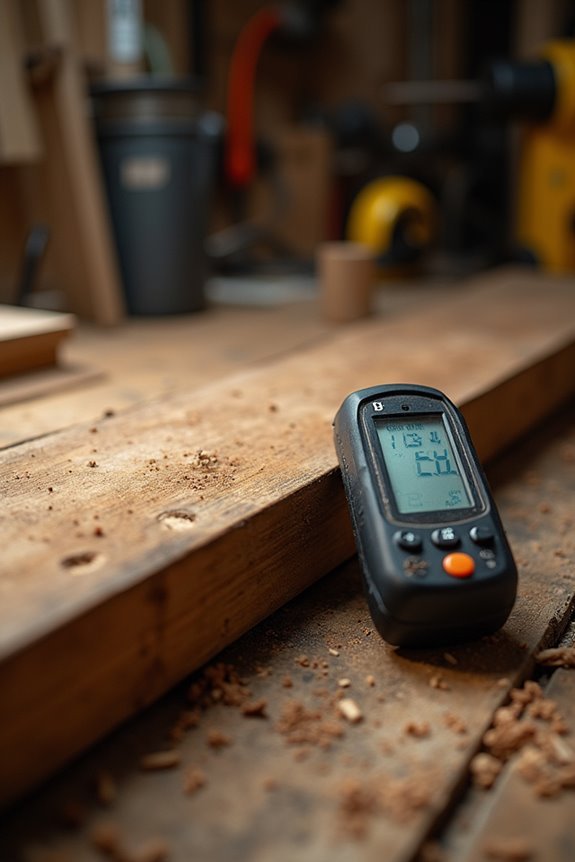
Because you don’t always need laboratory-perfect readings, budget moisture meters can actually serve a real purpose—just not the purpose you might think. I’ve found that cheaper moisture meters work best for spotting trends rather than precise values. They’ll show you which boards are drier than others, even if they’re off by 10–20% on absolute accuracy.
Think of budget meters as your rough-progress checkpoint. They’re perfect for comparing wet versus dry areas or watching wood gradually lose moisture over weeks. However, don’t rely on them for critical decisions like kiln shut-down timing or final conditioning checks.
The trick? Take multiple readings, cross-check suspicious spots, and corroborate findings with other methods. Your readings’ reliability improves dramatically when you’re simply tracking direction instead of demanding pinpoint precision.
Common Mistakes That Tank Measurement Reliability
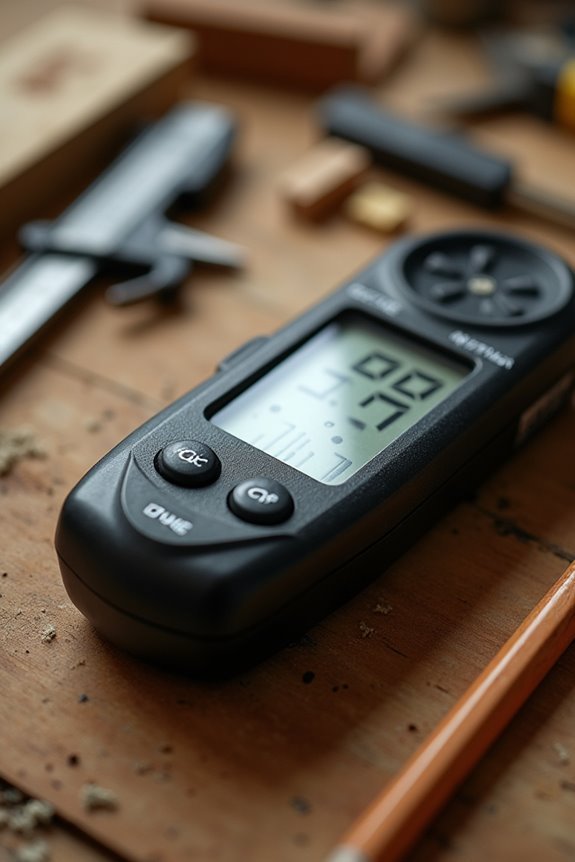
How much faith should you actually place in that single reading you just took?
I’ve learned that moisture readings aren’t gospel truth—they’re starting points. Here’s what tanks measurement variability:
- Testing painted or finished surfaces distorts readings because altered conductivity throws everything off
- Ignoring temperature effect and ambient humidity creates inconsistency; I always measure near room temperature for reliable results
- Relying on one spot instead of multiple areas misses the real moisture picture across your wood
Different meters give wildly divergent results on identical spots due to sensor type and calibration differences. Cheap meters? They’ll swing 5–20 percentage points from actual values. I’ve learned that cross-instrument comparisons without standardization are risky. The lesson here: take multiple readings, check your calibration regularly, and understand your meter’s quirks. That’s how you actually trust your data.